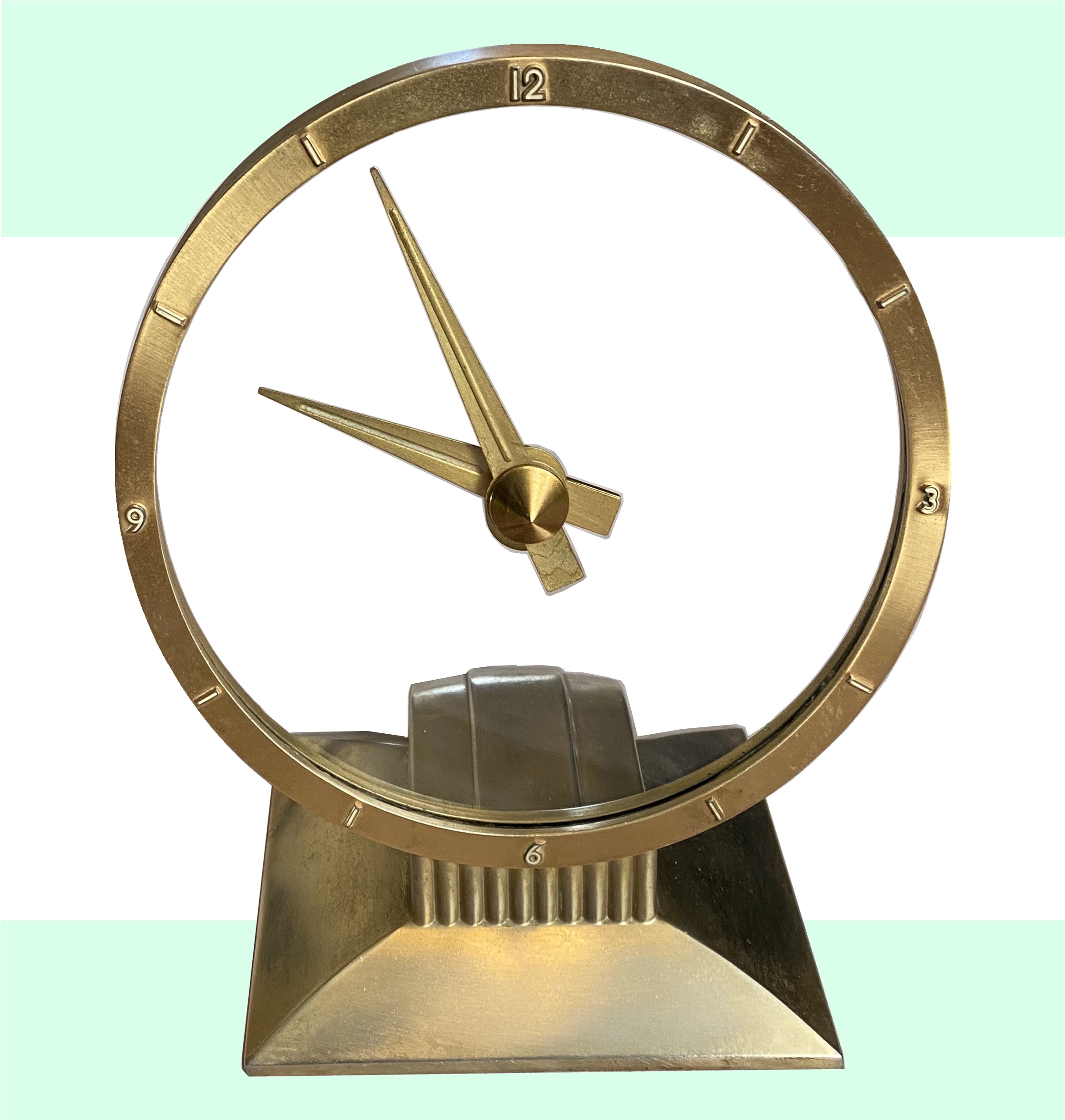
Museum Artifact: “Golden Hour” Mystery Clock, c. 1950s
Made By: Jefferson Electric Company, 840 S. 25th Avenue, Bellwood, IL
“So handsome on an office desk . . . so beautiful in the home! The ‘Golden Hour’ will be the most talked-about gift of all . . . a gift that reflects your own good taste, and above all, a gift that will be appreciated for years.” –ad for Jefferson Electric’s Golden Hour Electric Clock, 1952
 The “Golden Hour Mystery Clock” went into production at the suburban Bellwood, Illinois factory of the Jefferson Electric Company in 1949, and it would remain a very popular seller, with few alterations of any note, for several decades. There’s no need to explain what the appeal was, either. This thing looks as cool today as it did when it debuted, combining the “mystery” element of two magically floating clock hands with a classy, streamlined design and a bit of flashy gold shine—albeit achieved by a far more practical zinc alloy.
We’d love to say that Jefferson’s electrical engineer and resident clock designer Warren Ferguson schemed up this innovative concept all on his own, but the Golden Hour was—like so many iconic office props of the 1950s—a cheap, mass-produced version of a far pricer original.
In this case, it was adapted from a Dutch design that Jefferson Electric president James Bennan supposedly observed while on holiday in the Netherlands with his wife. The official patent for the Golden Hour was still credited to a Dutch inventor, a Mr. Leendert Prins, who described it as an adaptation of one of his earlier models: “a clock in which there is no apparent visible means for driving the time indicating hands thereof.”
Not to ruin the mystery or anything, but Prins also explained that the Golden Hour includes “two transparent rotating glass disks, on one of which the minute hand is mounted and on the other of which the hour hand is mounted. The peripheral edges of these disks are provided with gear teeth and the disks are mounted for rotation in a frame between two stationary glass disks.”
It’s a pretty simple set-up and a basic optical illusion, but people were consistently enamored with the result, to the tune of an estimated two million sales over the full 40-year lifespan of the Golden Hour Electric Clock. This is all the more impressive considering that its manufacturer, the Jefferson Electric Co., had never made a clock prior to this one.

[Leendert Prins’s US patent 2,642, 713, filed in 1949, approved in 1953: the basis for the Golden Hour Mystery Clock]
History of the Jefferson Electric Company, Part I: Chicago Years
There was nobody named Jefferson associated with Jefferson Electric when the company was established in Chicago in 1915—its patriotic founders just wanted to tip their cap to a former U.S. president and a fellow inventor, Thomas Jefferson. Those founders were John A. Bennan and James C. Daley, hailing from Moira, New York, and Kingston, Ontario, respectively.
 Daley was just 27 at the time, and newly arrived in Chicago from Canada. Bennan, the company’s first and longest-serving president, was 38 and considerably more seasoned. He’d been living in the South Side neighborhood of Kenwood since his teen years, and had spent most of his professional career with the Thordarson Electric Manufacturing Company, serving as its treasurer and general manager up until deciding to branch out on his own. Bennan’s old office with Thordarson had been on South Jefferson Street, so perhaps that played an additional role in his eventual branding idea.
Bennan and Daley set up their own shop at 847-851 West Harrison Street (Benjamin Harrison apparently being less worthy of a naming honor) and soon rolled out their first major product, a means for improving the performance of the headlights on the Ford motor cars of the period. The Jefferson Magneto Lamp Regulator was designed, more specifically, to “eliminate all lighting problems of the Ford car with absolutely no loss of current capacity.”
The automobile parts business was a mighty good one to be getting into, and Jefferson was soon off and running.
According to a later retrospective in Electrical Wholesaling magazine, the company became “well known as pioneers and leaders in what are called ‘small transformers.’” Up through World War I, these devices were mainly used for operating door bells, spark coils, signals, electrical toys (including American Flyer train sets), and early neon signs, but after the war, as the radio age began, Bennan and Daley expanded their focus accordingly, producing transformers for increasingly more refined styles of radio receiver sets.

[Two Jefferson Electric magazine ads, 1928-1929, indicating the range of uses for their small transformers]
By the late 1920s, after acquiring the like-minded Chicago Fuse Manufacturing Company, Jefferson Electric now had three factories—one at 426-430 S. Green Street, another at 501-511 S. Green Street, and a third at the corner of Laflin and 15th Street—all housing an impressive combined workforce of 1,800 people, split evenly between men and women.
Even the market crash of 1929 didn’t seem to pop the balloon, as Jefferson Electric paid $400,000 for a new, modern headquarters in Bellwood in 1931. They also had a Canadian subsidiary business up and running in Toronto. At the time, the Chicago Tribune reported that Jefferson was doing about $5 million in annual business, as their work with radio transformers and automobile fuses had left them at least somewhat impervious to the shrinking economy around them.

Part II: Bellwood Bound
In a 1933 issue of Electrical Wholesaling magazine, Jefferson Electric’s vice president, A. E. Tregenza, wrote an op-ed intended to serve as a sort of pep talk for his fellow businessmen in the electrical trade during the darkest years of the Great Depression.
 “Business is strictly a matter of people and is governed by their will,” Tregenza wrote. “It is a matter of Selling and Buying. It starts with selling, and its momentum is governed by the vigor of the selling effort. For a considerable time there has been a heavy business fog over the land. It is a fog of mental delusion that business starts with buying. Without aggressive selling there could be no business progress, and if we believe that business starts with buying, we are retrogressing. Business will go forward in exact pace with selling effort. We can’t go back and retain our self-respect—we must go forward.”
Clearly, the mindset in Jefferson’s Bellwood offices was to re-double their efforts in spite of the economic realities. Sometimes, however, this tunnel vision focus on selling left the company’s own employees holding the bag.
Bennan and Daley, now more than 20 years into their fruitful enterprise, weren’t big fans of collective bargaining or making room for visiting labor union reps. In 1938, they wound up having to defend themselves in a court case brought by the National Labor Relations Board, as organized workers at the Jefferson plant in Bellwood accused their bosses of lying about the union allegiances of its workforce, and worse yet, blocking workers’ ability to negotiate their own representation.
Bennan and Daley had worked out a deal behind the scenes with the International Brotherhood of Electrical Workers, whose representatives then set about strong-arming employees to join their ranks rather than sign up with the alternative option, the United Electrical and Radio Workers of America.
According to the testimony of employees, “Bennan’s attitude was openly hostile. He accused the United of being ‘small and petty’ and demanded to know why that organization did not come around to the front door when they started to organize. Further [Bennan] pointed out that the United representatives were young fellows and asked, ‘Did either one of you ever do a hard day’s work in your life?’”

Despite this ongoing tension, and the fact that the Jefferson workforce was now about half of its pre-Depression manpower, the company still managed to grow and prosper. By 1940, a now 63-year-old Bennan told his shareholders that “It seems likely to us that business will continue to pick up. We expect 1940 to be considerably ahead of last year.”
Bennan didn’t know that America’s impending entry into World War II was about to lead to another major pick-up in business, as Jefferson Electric earned a contract producing transformers for the Navy. During its years as a military supplier, though, the company kept an eye on its post-war opportunities.
“The great capacity of the Jefferson Electric plant, made good use of in producing vast quantities of transformers required for military uses, will be ready to serve you promptly when Victory is won,” read a 1944 Jefferson ad in a trade magazine. “Having full control of the manufacture of all parts in our own plant, and the ability to give you laboratory accuracy and precision in mass production, assure you uniform, high-quality Transformers to meet still better your post-war needs.”

Part III: A Matter of Time
John A. Bennan died in 1947, and was followed in 1952 by company co-founder James C. Daley.
Three of Bennan’s sons were already working with the business in the years before his death, and the eldest, James M. Bennan, took over the presidency of the company in 1949, making him the key figure in Jefferson Electric’s surprise entry into the clock business that year. By 1953, with the Golden Hour Mystery Clock giving the company its widest mainstream exposure to date, James presided over the first major expansion of the Bellwood plant.
 “We look upon our future growth so confidently,” James Bennan wrote in a trade magazine ad marking the 35th anniversary of his family’s business, “because during our first 35 years we have developed the essential engineering, research, manufacturing technique and control. We can put this long experience to good use to assure continued uniform high quality in quantity production.”
The clocks department was always kind of its own corner of the operation, and its products never became the prevailing money-makers of the business. They were steady earners, though, advertised throughout the 1950s and ’60s in major supermarket magazines like Vogue and Life. Not accustomed to the consumer market or dealing with retailers, however, Jefferson Electric chose to sell their new clocks outside not in stores, but by teaming with industrial gift distribution houses and catalog companies that could handle big orders. As such, clocks like the Golden Hour always remained in the “novelty gift” category—something you’d order for a retiring employee or as a handout for an awards show.
“Display the “Golden Hour and you’ll sell it!” read one ad in a trade magazine, featuring an accompanying countertop cardboard sales display “specially designed to call attention to the ‘see thru’ feature of the clock. It’s yours for the asking!”

[The aggressively promoted Jefferson “Golden Hour” Electric Clock, which landed on thousands of desks in the 1950s, including that of Lucille Ball, pictured top center, who was gifted one at a charity event in 1955 by the vice president of the ABC Network]
The marketing situation wasn’t ideal, as Jefferson’s VP of Sales J.D. O’Brien openly admitted in a piece published in Sales Management in 1954, noting that they were basically trapped into selling their clocks at discount prices.
“We have seriously thought of getting out of this profitable mess,” O’Brien wrote, “but no one would notice us if we did, simply because our consumer product is of mighty small consequence in the vast electrical appliance market. . . . Right now it looks like quick death to try it by our lonesome.”
 Then, just like that, a very different sort of quick death befell the Jefferson Electric Company.
Just as he was settling into his role as the president and chairman of the firm, James Bennan’s time was up—his life snuffed out in a gruesome, freak accident that shook the company, his family, and much of the wider Chicago manufacturers industry of which he’d been a part.
Bennan and his wife Elizabeth were visiting his sister Mary in Evanston on a random February afternoon in 1955. When their car stalled out in the driveway as they were leaving the house at 642 Sheridan Square, James elected to open up the hood to have a look at the engine while Elizabeth sat behind the wheel. “Then, still in front of the car, [Bennan] told his wife to step on the accelerator,” the Chicago Tribune later reported. “As she did, the car moved forward with Bennan clinging to the hood. It crossed the street and struck a parked car, then kept going for another few feet until it hit a fence. Bennan was crushed under the left front wheel of his own auto.
“Mrs. Bennan told police she knows how to drive, but that she was paralyzed by fright.”
James Bennan, who had served as a lieutenant commander in the Navy for three years during World War II, was dead on a quiet suburban street at just 44, leaving behind a traumatized wife, two sons, and two younger brothers.

Part IV: Conglomerations
It fell to one of James Bennan’s brothers, Edward J. Bennan, a WWII Army Air Corps vet, to take over the business. He would handle that role for the next dozen years, from 1955 to 1967, before opting to sell Jefferson Electric to a conglomerate called Litton Industries. Edward would later state that “it was a good deal at the time,” despite Jefferson still doing a solid $25 million in annual sales as an independent.
 As no coincidence, Edward Bennan and his own son Dean would eventually start an advisory business in the 1970s specializing in mergers and acquisitions.
Jefferson Electric, meanwhile, continued as a subsidiary of Litton Industries, one of the first true multinational mega-conglomerates of the mid 20th century. By the 1980s, the California-based Litton had over 75,000 employees, 90 different divisions, and at least 80 factories under its control in a wide range of industries across the continent. It also developed a reputation, not unlike Jefferson Electric back in the 1930s, of being a union buster.
Only 20 percent of Litton’s massive workforce were unionized in 1982, and in a case brought to the Labor Relations Board, it was alleged that the company had eliminated 500 jobs at the old Jefferson plant in Bellwood once the workers there started organizing again, relocating those roles to a different factory in Alabama.
Litton finally decided to sell off Jefferson Electric and several of its other electronics subsidiaries in 1984, with Jefferson becoming a division of MagneTek, Inc. In 1985, the firm was forced to move out of its Bellwood plant after 50 years, briefly opening up a new office in Downers Grove. Manufacturing of Jefferson electric clocks still carried on until the end of the 1980s, when competition from cheaper foreign-made digital clocks finally buried the Golden Hour and the rest of the Jefferson clock line-up.

The company had fully abandoned the Chicago area by the 2000s, but a 200-person plant was in operation in Franklin, Wisconsin, still making transformers and small electronics in the way Jefferson Electric had since 1915. In 2024, however, a private equity firm bought the business and merged it with another company to create a new entity known as Voltaris, with Jefferson surviving only as a line of products rather than a firm unto itself.
 The Bellwood era of the company, which lasted from 1931 into the mid 1980s, is becoming quickly forgotten, as even the longstanding Jefferson Electric building has recently been demolished. For several generations, though, thousands of workers made their lives and livelihoods there, including Fred and Mildred Delaney, who met at the offices there in the 1950s, got married, continued working together at the Jefferson building until their retirements in the 1970s, and then found themselves the subject of a newspaper story in 1993, highlighted by the Chicago Tribune for their work as hospital staff volunteers at Lutheran General Hospital in Park Ridge.
“During our working career,” an 80-year-old Fred Delaney, a former salesman at Jefferson, explained, “it was required that you work and you just got into a habit of working. It’s a hard habit to break. You just don’t sit around and do nothing. . . . It’s the satisfaction of being useful.”


Sources:
“Jefferson Electric Manufacturing Co.” [establishment of] – The Electrical News, March 1, 1915
“He Made Small Transformers a Big Business” – The Jobber’s Salesman, June 1925
“Companies Combine” (Jefferson Electric and Chicago Fuse MFG) – Battery Man, Vol. 9, 1928
“Buys 19 Acres in Bellwood for $550,000 Plant” – Chicago Tribune, July 5, 1931
“Three Essentials” – by A. E. Tregenza, Electrical Wholesaling, April 1933
“Jefferson Electric Co. vs. National Labor Relations Board” – United States Court of Appeals for the Seventh Circuit, 1938
“John A. Bennan” [obit] – Electrical Wholesaling, June 28, 1947
“James C. Daley” [obit] – Midwest Engineer, March 1952
“James C. Daley Wills $1,661,782 to Eight Daughters” – Chicago Tribune, Sept 17, 1953
“‘Legitimate Retailers Made Us Turn to Discounters” – by J. D. O’Brien, Sales Management, May 1, 1954
“Crushed by Own Auto” – Chicago Tribune, Feb 11, 1955
“Hottest Game in Town: Undoing Management Mistakes” – Houston Chronicle, July 6, 1975
“Litton Sells Louis Allis” – The Journal Times (Racine, WI), April 4, 1984
Labor Relations: A Diagnostic Approach, by Kenneth A. Kovach, 1992
“The Dutch Secret and Jefferson Electric Clock History” – by Roger Russell, NAWCC Bulletin, October 2004
I found my clock going out the door with someone’s trash. It works just exactly as a clock should. So just like the saying goes… trash can definitely be treasure! If someone is interested in buying this from me, make an offer. I am letting go of so many items at very low prices, nothing even remotely close to it’s actual worth.. I have too many items.
Everybody, go to Youtube.com and search Jefferson Electric Mystery Clock and you find lots of info and how some people have repaired them.
I had a golden hour clock that had a clear plastic rectangular box covering the face of the clock. The clock repair guy lost the clock. I can’t find another. I looked in your catalog and couldn’t find that model. Did you produce that model ever?
Thanks for your attention…..
Carl
Clock- Jefferson “Golden Hour” electric clock. My clock won’t work. I haven’t used it for quite a few years. It worked the last time we used it. It is 115 V.A.C. 606cyonly 2.5 watts Cat#580-101. Can it be fixed?
My husband & I received one of these clocks for our wedding June 22, 1957. He passed away in 2002. I haven’t used it for quite a few years and I plugged it in but it doesn’t work. I must admit, I don’t really know much about the clock, but we really liked it and I’m wondering if you can tell me what I need to do. Do I need to take the bottom off?